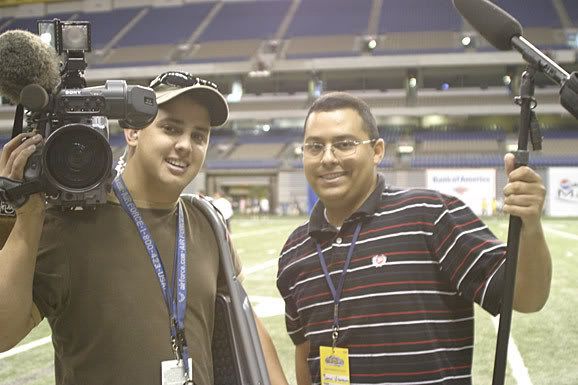
Photo courtesy Nick Wheeleroz “At first it seemed like just hype, but after using the camera and reviewing my footage, I was blown away” (Lerma, par 2). Sam Lerma, an independent film maker and instructor at the Film School of San Antonio at Harlandale High School, is talking about his use of what is primarily a still photography camera that is blazing its way into the video production market. Ten years ago, most professional photographers were in the beginning steps of making the transition from film to digital. One early digital camera was a hybrid between a Canon or Nikon body and a Kodak digital chip that was only capable of capturing images up to two megapixels. At that time, two megapixel resolution was cutting edge technology. The photography industry has dramatically changed in the past decade and continues to change. The lines between video and photography cameras are blurring, and one camera is leading the way. The Canon EOS 5D Mark II is a great camera because of its impressive imaging abilities, available accessories, easy to use interface, and reasonable price point.
There are some aspects of the camera that could be improved, the majority of which are in regards to the video capturing. Since the camera is predominantly designed for photography, the ergonomics of the 5D Mark II are not well suited for shooting video. Many third party manufacturers, however, have created many accessories to make the camera handling imitate traditional video cameras. Even with the third party accessories, the 5D Mark II is not close to completely replacing more traditional video cameras. Robert Paniagua, who has two decades of experience as an international video journalist and proprietor of ETC. Video Pro, notes that under tight deadlines and projects that need a quick turnaround, shooting video with the 5D Mark II is “not very practical for everyday use because of the necessary attachments” (Paniagua, par 6). There were some problems with “jerky” video when the camera was first released. Canon, however, has since released a firmware upgrade that fixes many of those initial issues. Firmware is a “computer program contained permanently in a hardware device” (“firmware”). The 5D Mark II is also limited by the amount of time that video can be continuously recorded. Sam Lerma, whose short film, Trash Day screened at film festivals around the world and won several awards including best director at The Long Island Latino Film Fest, employed the Canon 5D Mark II on his recent documentary, Inside the House of Usher. He observes, “The camera can only record in 10 minute clips…stopping interviews to change out cards can get annoying” (Lerma, par 5).
The Canon 5D Mark II is capable of creating stunning images, with a shallow depth of field that gives independent film makers a filmic look they crave, while holding up to the strict standards of a professional photographer. The 5D Mark II is a digital single lens reflex camera, or DSLR, that boasts a full frame complementary metal-oxide semiconductor, or CMOS sensor. It is capable of capturing 1920 by 1080 progressive high definition video at thirty frames per second. The 5D Mark II’s closest competitor is only capable of shooting 1280 by 720 video and photos at 12.3 megapixels. Most cameras on the market today, including many professional cameras, have smaller sensors that crop and magnify an image when used with 35 millimeter lenses. Full frame sensors are the same size as a 35 millimeter film frame and have a better dynamic range or contrast. The full frame CMOS sensor with a twenty one megapixel resolution and Canon’s DIGIC 4 image processor combine to make stunning images. “The first thing we noticed after shooting off a fair number of stills was how sharp and clear the images came out. The color processing is outstanding” (Holland, par 4). The 5D Mark II has an ISO range of fifty to two hundred fifty six thousand. ISO is a measurement of how sensitive film is to light. As the ISO increases, less light is needed for a properly exposed image, although the amount of noticeable grain increases. “The capability to shoot at an ISO of 25600 lets you practically shoot in the dark. While I wouldn't shoot everything at such a high ISO… the camera will be able to perform in the low-light situations I might find myself shooting in” ("Canon EOS 5D Mark II," par 18). Because of its impressive image quality, the 5D Mark II has been used in the production of national commercial spots, the new show open for Saturday Night Live, primetime television shows on major broadcast networks such as the 2009-2010 season finale of “House” on the FOX network, and many other high profile productions.
Robert Paniagua, who after a recent trip to the 2010 National Association of Broadcasters Show in Las Vegas, noted the “5D Mark II was at many of the major exhibits” (Paniagua, par 2). New accessories to enhance shooting video with the camera, such as “follow focus” devices and steady cam rigs for smooth camera movement, are coming to the market nearly every day. The camera is also compatible with many pre-existing accessories designed for other camera bodies in Canon’s EOS line, allowing the 5D Mark II to be easily integrated into the equipment already owned by many photographers. Wireless transmitters, memory cards, lenses, flashes, and flash accessories are just some of the types of equipment that are compatible with the camera. “The big bonus, however, is the glass - the ability to use the extensive collection of photographic lenses available for DSLR cameras, giving you amazing flexibility in controlling focal length and depth of field” (Dixon, par 3). Other accessories allow the camera to instantly transfer photos wirelessly, as they are snapped, to a backup server and can be instantly seen from anywhere in the world with internet access.
The easy to use interface is very simple and similar to other cameras in Canon’s EOS line of digital single lens reflex cameras. The 5D Mark II allows fully manual operation, fully automatic operation, and various levels of control in between. The controls include shutter speed, aperture, ISO, white balance and focus. The photographer can change the auto focus setting to focus on objects in the center of the frame or one of nine focus points within the frame. The 5D Mark II also has a 3 inch “live view” liquid crystal display, or LCD, giving the photographer the option to either look through the view finder, or at the LCD display while shooting. There are several file formats to choose from while shooting. When shooting in “Raw” mode the image remains uncompressed and all the raw data is saved resulting in a much larger file size. Several compression settings save photographs in the .jpg format while video is saved as a .mov file.
Independent film makers and photographers love the 5D Mark II not only for its imaging abilities but for its relatively affordable price also. Former National Press Photographers Association president, veteran photojournalist, and wedding photographer Todd Stricker comments, “The 5D Mark II is a great camera, far superior to any of the others I have used in the past. And in my opinion better suited to the work I do than other more expensive Canon cameras that I have worked with” (Stricker, par.3 ). While other camera bodies can capture up to 54 megapixels, they also carry an exorbitant price tag. The Mamiya DM56 retails for over thirty two thousand dollars. The 5D Mark II delivers a powerful professional camera body at a manufacturer’s suggested retail price of two thousand five hundred U.S. dollars. That price does not include a lens which is standard with professional level cameras. Independent film makers are now able to achieve the coveted film look that previously required very expensive film cameras that were predominantly available only to large budget film studios and commercial production houses. Dave Williams, of Dave Williams Films in Philadelphia, comments “In skilled hands, these cameras blow away what is available for even three times the price in video right now. I don't ever see going back to regular video cameras" (Merfeld, par 6).
The Canon EOS 5D Mark II is an outstanding camera that is shaking up the creative imaging industries because of its exceptional imaging capabilities, easy to use controls, wide range of accessories available for both video and photography, and relatively reasonable price point. As new accessories are developed, the few inadequacies the camera may have are fading away. As video cameras and photography cameras merge, the Canon EOS 5D Mark II is an innovative leader. In the relatively short two years it has been on the market, the camera has had a profound effect on an entire industry. The 5D Mark II could be the genesis of a transformation in the video production industry the way digital cameras revolutionized the photography industry nearly a decade ago.
Works Cited
"Canon EOS 5D Mark II." Studio Photography & Design 12.3 (2009): 34. General OneFile.
Web. 12 Apr. 2010. Document URL http://proxy.nlc.alamo.edu:2058/gtx/infomark.do?&contentSet=IAC-Documents&type=retrieve&tabID=T003&prodId=ITOF&docId=A196293654&source=gale&srcprod=ITOF&userGroupName=txshracd2907&version=1.0
Dixon, Doug. "HD video DSLRS: a different kind of camcorder." Videomaker 24.10 (April
2010): 41(5). General OneFile. Gale. Northeast Lakeview College. 12 Apr. 2010
"firmware." Merriam-Webster Online Dictionary. 2010. Merriam-Webster Online. 13 April 2010
http://www.merriam-webster.com/dictionary/firmware
Holland, Brent. "DSLR in motion: Canon 5D Mark II Digital SLR Camera with Video."
Videomaker July 2009: 18+. General OneFile. Web. 12 Apr. 2010. Document URL
Lerma, Sam. Personal interview. 12 Apr. 2010.
Merfeld, Elizabeth Avery. "Adventures in fusion, part 1." EventDV 22.9 (2009): 30+. General
OneFile. Web. 12 Apr. 2010. Document URL
Paniagua, Robert. Personal interview. 18Apr. 2010.
Stricker, Todd. Personal interview. 14 Apr. 2010.